
HP HPE7-A10 Free Exam Questions (Updated 2026)
-
-
PDF Questions

-
Bundle Pack
-
Online Engine
-
-
Question No 1
A client connects to an AOS-CX switch that tunnels the client’s traffic to an AOS-10 gateway. The gateway places the client in a role with these rules:
any any svc-dhcp permit
user alias host1 svc-dns permit
user alias net1 svc-https permit
user alias net2 tcp 8086 permit
user alias net3 any deny
user alias net4 svc-https permit
The gateway defines these aliases:
host1 = 10.0.6.8
net1 = 10.0.0.0 255.255.252.0
net2 = 10.0.3.0 255.255.255.0
net3 = 10.0.0.0 255.255.248.0
net4 = 10.0.0.0 255.255.0.0
The client sends these two packets:
1: tcp 8086 to 10.0.3.75
2: https to 10.0.7.24
What occurs?
Question No 2
You are designing an AOS-10 architecture and ClearPass solution for a manufacturing company with legacy equipment that supports only WPA2. You need to improve security for these devices.
This equipment will connect to an SSID named "Factory." If equipment passes authentication and is assigned the custom Device Category "Manufacturing," it must receive this AOS user role:
"equipment." That role, along with a "profiling" role for unprofiled devices, is already configured on the AOS devices.
The users who configure PSKs on the equipment belong to the "FactoryAdmins" group in the company's Active Directory domain. CPPM has an authentication source for that domain named MyAD. As part of the solution, you have created these services on CPPM:
Service 1:
Type: Application
Authentication source: MyAD
Authorization source: None
Enforcement policy:
Rule 1 condition: Authorization:Endpoints Repository:Category EQUALS Manufacturing
Rule 1 profile list: Enforcement profiles that permit application access and assign the Guest Operators role
Default action: Deny access
Service 2:
Type: Wireless with mPSK
Authentication source: Guest Devices Repository
Authorization source: None
Enforcement policy:
Rule 1 condition: Endpoint Device Insight Tag EQUALS Manufacturing
Rule 1 profile list: Enforcement profile that assigns Aruba-User-Role = equipment and [Registered Device MPSK] profile
Rule 2 condition: Endpoint:Device Insight Tag NOT_EXISTS
Rule 2 profile list: Enforcement profile that assigns Aruba-User-Role = profiling and [Registered Device MPSK] profile
Default action: Deny access
What is incorrect in this configuration?
Question No 3
Customer introduction
You are assisting a company with adding HPE Aruba Networking ClearPass to its network, which uses HPE Aruba Networking infrastructure devices.
The company currently has a Windows domain and a Windows CA. The Windows CA issues certificates to domain computers, domain users, and servers such as domain controllers. An example certificate issued by the Windows CA is shown here.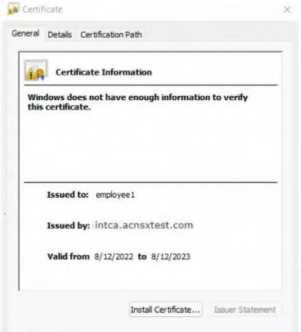
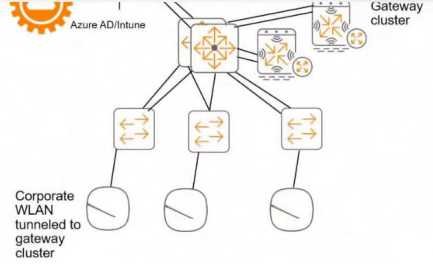
ClearPass cluster IP addressing and hostnames
A customer's ClearPass cluster uses these IP addresses:
Publisher = 10.47.47.5
Subscriber 1 = 10.47.47.6
Subscriber 2 = 10.47.47.7
Virtual IP with Subscriber 1 and Subscriber 2 = 10.47.47.8
The customer’s DNS server has these entries:
cp.acnsxtest.com = 10.47.47.5
cps1.acnsxtest.com = 10.47.47.6
cps2.acnsxtest.com = 10.47.47.7
radius.acnsxtest.com = 10.47.47.8
onboard.acnsxtest.com = 10.47.47.8
Refer to the scenario.
The customer has now decided it needs CPPM to assign certain mobile-onboarded devices to a "nurse-call" AOS user role. These mobile-onboarded devices communicate with IP address 10.1.18.12 using port 4343.
What are the prerequisites for meeting this requirement?
Question No 4
Introduction to the customer
You are assisting a company with adding HPE Aruba Networking ClearPass to its network, which uses HPE Aruba Networking network-infrastructure devices.
The company already has a Windows domain and Windows CA. The Windows CA issues certificates to domain computers, domain users, and servers such as domain controllers.
ClearPass cluster IP addressing and hostnames
Publisher = 10.47.47.5
Subscriber 1 = 10.47.47.6
Subscriber 2 = 10.47.47.7
Virtual IP with Subscriber 1 and Subscriber 2 = 10.47.47.8
Refer to the scenario.
Assume that you configured CPPM to assign HPE Aruba Networking ClearPass roles and AOS user roles as indicated in the scenario. However, a penetration tester was able to access the network with medical-staff privileges on a client with a valid computer certificate but a revoked medical user certificate. In this situation, the customer wants the client to receive computer-only access.
What can you do to resolve this issue while continuing to meet the other customer requirements?
Question No 5
Introduction to the customer
You are assisting a company with adding HPE Aruba Networking ClearPass to its network, which uses HPE Aruba Networking network-infrastructure devices.
The company already has a Windows domain and Windows CA. The Windows CA issues certificates to domain computers, domain users, and servers such as domain controllers.
ClearPass cluster IP addressing and hostnames
Publisher = 10.47.47.5
Subscriber 1 = 10.47.47.6
Subscriber 2 = 10.47.47.7
Virtual IP with Subscriber 1 and Subscriber 2 = 10.47.47.8
Refer to the scenario.
You imported the root certificate for the Windows CA into the ClearPass CA Trust list. Based on the scenario requirements, which usages should be added to it?
-
Page: 1/15
Total 75 Questions